How to Identify Trees by Their Bark (12 Common Examples)
Learn to read bark: colour, texture, ridges, plates and peeling. Twelve common North American trees you can name from the trunk alone, even in winter.
The Wood Ai team
Nov 23, 2026 · 4 min read
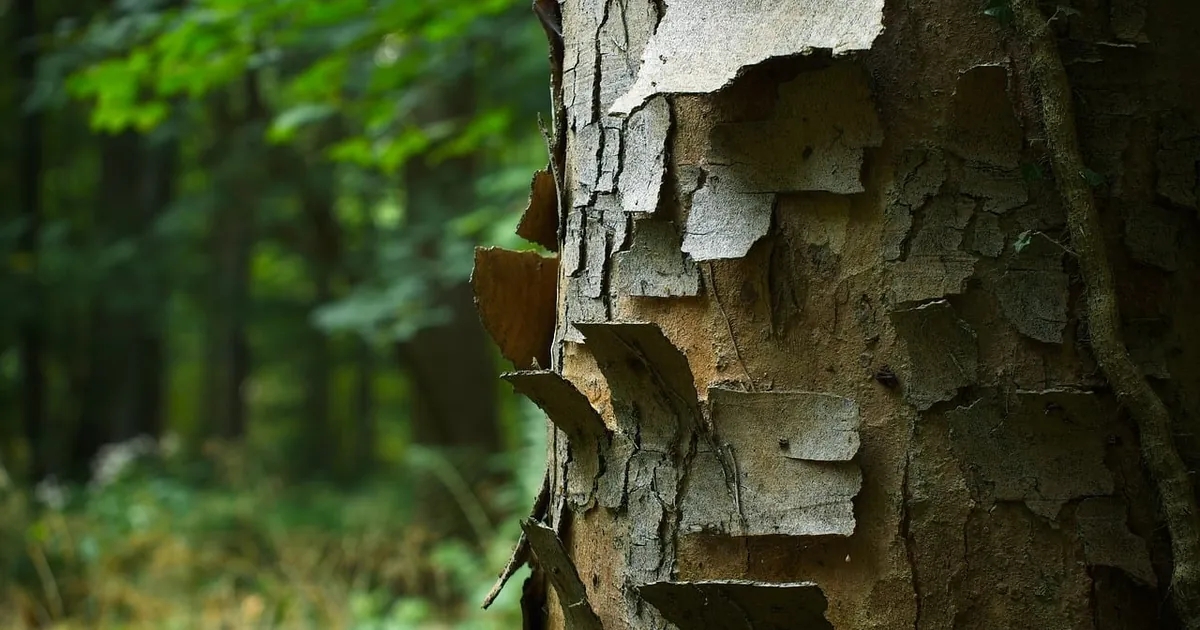
Leaves are the easiest way to name a tree, but they are only there for half the year, and often far above your head. Bark is always at eye level. With a little practice you can name most common trees in a park or woodland from the trunk alone, in any season.
What to look at
Stand at the trunk of a mature tree and check four things:
- Colour: light grey, dark grey, brown, near-black, white, reddish.
- Texture: smooth, furrowed (long grooves), plated (flat scales or blocks), shaggy, or peeling.
- Ridge shape: are the ridges long and straight, interlaced in a diamond pattern, or broken into blocks?
- Marks: horizontal lines (lenticels), thorns, warts, or wounds.
Bark changes as a tree ages, so compare trunks of similar size, and treat young saplings separately: most of them have smooth bark whatever the species.
12 trees you can name by the bark
1. Paper birch
Bright white bark that peels in thin, papery strips, marked with dark horizontal lines. Older trunks turn darker and rougher near the base. Grey birch is similar but does not peel freely.
2. American beech
Smooth, light grey bark that stays smooth for life, even on huge trees. It is often described as elephant skin. Because it is so smooth, it is also the tree most often carved with initials.
3. Shagbark hickory
Long grey plates that pull away from the trunk and curl outward at the ends, giving a shaggy look. Hard to confuse with anything else once the tree is mature.
4. American sycamore
A camouflage pattern: the brown outer bark flakes off in patches to reveal cream, white and green underneath. Upper branches are often bright white, visible from far away in winter.
5. Black cherry
Young trees have smooth, reddish-brown bark with short horizontal lines (lenticels). Mature trunks break into dark, scaly plates with curled edges, often compared with burnt potato chips.
6. White oak
Light ash-grey bark in shallow, scaly plates or blocks, often loose on the edges. Paler than almost any other oak.
7. Northern red oak
Dark bark with long, flat-topped, shiny ridges running up the trunk between darker furrows; foresters call them "ski trails". The ski trails are clearest in the upper trunk. Our guide to red oak vs white oak covers the other differences.
8. Sugar maple
Grey bark in long, irregular vertical plates on older trees, which often curl outward along one edge. Young trees are smooth and grey-brown.
9. Black walnut
Dark brown to almost black, with deep furrows and rounded ridges that interlace in a diamond pattern. Scratch a ridge and the inner bark is chocolate brown.
10. Quaking aspen
Smooth, pale greenish-white to cream bark with dark scars where branches fell off, often looking like eyes. The base of old trees turns dark and furrowed.
11. Eastern white pine
Young trees have smooth, grey-green bark. Mature trunks are dark grey with deep furrows and broad, flat ridges. The straight trunk and branches in whorls are extra clues.
12. Honey locust
Dark grey-brown bark in long, thin plates that lift at the edges. Wild trees often carry large, branched thorns on the trunk; many city trees are a thornless variety, so no thorns doesn't rule it out.
Quick comparison
| Bark | Likely tree |
|---|---|
| White, peeling in paper strips | Paper birch |
| Smooth, light grey, even when old | American beech |
| Long plates curling at the ends | Shagbark hickory |
| Patches of brown, cream and green | American sycamore |
| Dark, scaly "potato chip" plates | Black cherry (mature) |
| Light grey, scaly plates | White oak |
| Dark with shiny flat ridges | Northern red oak |
| Grey plates curling along one side | Sugar maple (mature) |
| Near-black, diamond-pattern ridges | Black walnut |
| Smooth pale green-white, dark "eyes" | Quaking aspen |
| Big branched thorns on the trunk | Honey locust (wild type) |
When bark is not enough
Some groups need more than bark: the many red oaks, the ashes, the elms and the maples often look alike on the trunk. Add a second clue:
- Buds and twigs in winter: opposite or alternate, colour, shape.
- Fallen leaves and fruit under the tree: acorns, samaras, hickory nuts, gumballs.
- The overall shape of the tree and its branching.
The quickest way is to let the app do the comparison. Take one sharp photo of the bark in daylight, filling the frame, and run it through our free tree identifier. In the Wood Ai app you can add a leaf or a seed to the same scan for a more certain match, and save the tree to your collection.
Once you have the name, our guide on how to identify wood shows how the same tree looks as lumber.
Frequently asked questions
Can you identify a tree from bark alone?
For many common trees, yes, especially mature ones. For close relatives (different oaks, maples or ashes) combine bark with buds, twigs, leaves or fruit.
Why does bark look different on young and old trees?
Young bark is usually smooth and thin. As the trunk grows, the outer bark cracks into ridges, plates or strips. Cherry, pine and maple change the most with age.
Does moss or lichen help identify a tree?
Not really. They grow on many species and can hide the bark pattern. Look at a clean patch of the trunk.
What is the best time of year to learn bark?
Winter. With the leaves gone, bark, buds and branching are all you have, and you learn to use them fast.